

Learn how welding curtains improve safety, compliance, and workspace efficiency in industrial and workshop settings.
Walk into a busy fabrication shop, and you’ll notice it quickly. Sparks scatter across steel, arcs flare white-blue, and multiple jobs run side by side, often closer than they should be. That environment isn’t unusual. What’s often overlooked is how exposed everything else is, especially the people not directly involved in the weld.
That’s where welding curtains tend to move from optional to necessary.
Welding curtains are not complicated equipment; they have no moving parts or electronics. Still, their role in controlling risk is often underestimated until something goes wrong. And by then, it’s usually too late for a simple fix.
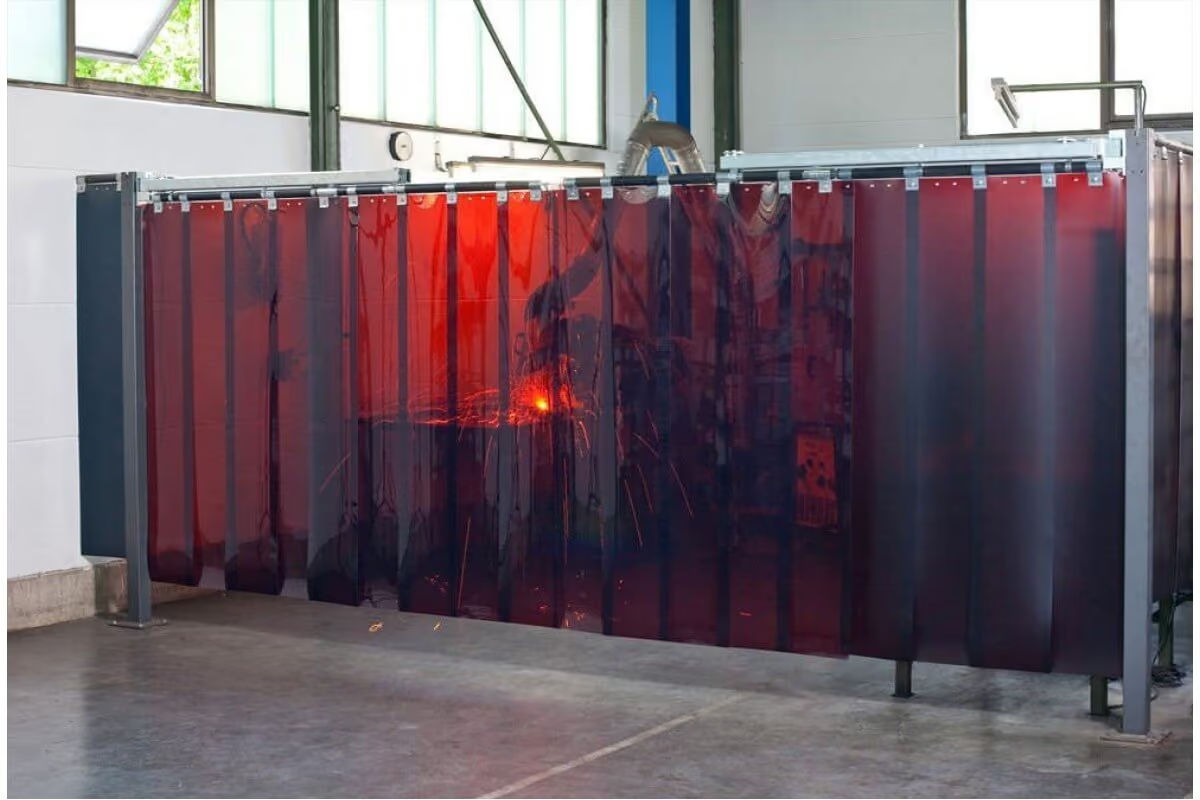
At their core, welding curtains act as a barrier. Not for physical force, but for radiation, light, and heat.
Arc welding produces intense ultraviolet and infrared radiation. It doesn’t just affect the welder. Anyone within line of sight, even across the shop floor, can experience arc eye. Symptoms are not always immediate; sometimes they appear hours later, making it easy to dismiss the cause.
Curtains reduce exposure—not entirely, but sufficiently to create a controlled environment.
Standard welding helmets protect the operator. That’s expected. The issue is everyone else. Helpers, inspectors, or even someone walking through the area.
Curtains create a visual boundary, serving as much as a signal as a shield.
Open workspaces rarely stay organized; jobs shift, people move, and equipment is often repositioned. Without some form of separation, welding zones bleed into general work areas.
A properly installed curtain keeps sparks and light contained, not perfectly but significantly.
The value of welding curtains goes beyond blocking light. It’s a layered safety approach.
Welding curtains provide UV and IR protection, reducing harmful radiation exposure. Quality curtains are designed to filter harmful wavelengths. Not eliminate them completely, which would affect visibility, but reduce exposure to safer levels.
It’s a balance. Too dark, and workflow slows; too transparent, and protection drops.
Most industrial-grade curtains are treated to resist ignition. That matters more than people think. Sparks travel. Sometimes farther than expected, especially in shops with airflow or open layouts.
Regulatory standards vary, but the expectation is consistent. Employers are responsible for protecting not just welders, but everyone in the vicinity.
Curtains aren’t always explicitly required, yet they often form part of a compliant setup.
Not all welding curtains perform the same. Choosing the wrong type can create a false sense of safety.
These are common for a reason. Flexible, durable, and relatively easy to install.
They handle sparks well and provide consistent UV filtering. Most workshops rely on them as a baseline solution.
Used where visibility matters. Supervisors can monitor work without stepping into the welding zone.
There’s a trade-off. Transparency slightly reduces protection, so placement becomes more important.
Green and amber tints are typical. They help reduce glare while maintaining enough visibility for surrounding tasks.
Many shops find that tinted options strike a practical balance between safety and workflow.
Instead of a single panel, these use overlapping strips. They’re useful in high-traffic areas where workers or materials move in and out frequently.
They don’t seal perfectly, though. Gaps can form, especially if strips wear unevenly.
Selection isn’t always straightforward. A curtain that works in one shop might fail in another.
Larger spaces may need modular systems. Smaller setups can get by with fixed panels.
Coverage matters more than cost here. Partial protection often creates blind spots.
MIG, TIG, and stick welding. Each produces different levels of light and spatter.
Welding processes with higher intensity demand thicker or more specialized curtain materials.
Some shops prefer portable frames. Others install permanent barriers.
Mobility adds flexibility but can introduce inconsistency if not positioned correctly each time.
Thicker materials offer better durability. Color affects visibility and comfort.
There’s no universal answer. It depends on how the space is used day to day.
Compliance is often discussed in checklists, but real-world application is less tidy.
Curtains should extend from above head height to near the floor. Leaving gaps, even small ones, allows light leakage.
That’s often where issues start.
Too much opacity can create blind spots. That introduces a different kind of hazard.
Some compromise is inevitable. The goal is to manage it, not eliminate it entirely.
Even the best welding curtains won’t perform if installed poorly.
Track-mounted systems allow adjustment, while fixed frames offer stability.
Each has its place, but what matters most is consistency in positioning.
Partial coverage is a common mistake because light doesn’t stay contained even with a barrier.
Full vertical coverage reduces that risk significantly.
Corners, overlaps, entry points. These are weak spots.
Regular checks help, especially in busy environments where setups shift often.
Choosing the right welding curtains isn’t only about meeting minimum safety expectations. Durability, usability, and real-world performance tend to matter more over time.
Some suppliers design products based on lab conditions, while others build them from real-world shop experience. That difference shows up after a few months of daily use.
Tentacle Tools approaches this from a practical angle. Their gear is shaped by actual shop conditions, not just specifications on paper. For welders looking to upgrade safety setups without overcomplicating their workflow, it may be worth reviewing their available options and seeing how those products align with real operational needs.
If your current setup feels temporary or inconsistent, reassess it before it becomes a safety liability.
Check out Tentacle Tools—gear built for real-world welding, not just specs!
Even well-equipped shops run into preventable issues.
Cheaper curtains degrade faster. They fade, crack, or lose their protective properties.
Short-term savings rarely last.
Too short, and exposure leaks underneath. Too high, and sparks can travel beyond coverage.
Precision matters here more than most expect.
Curtains aren’t install-and-forget equipment. They collect residue, sustain minor damage, and gradually wear down.
Routine inspection keeps them effective.
It’s tempting to treat welding curtains as standalone protection. In practice, they work alongside other equipment.
Welding safety gear forms a system. Helmets, gloves, protective clothing, and barriers all contribute in different ways.
A welder wearing proper welding helmets and welding sleeves is protected individually. Add welding aprons, and coverage improves further. Introduce controlled workspaces with curtains, and risk drops for everyone else.
Even workstation design plays a role. Properly positioned welding tables can limit spark spread and improve containment.
No single element solves everything; together, they reduce exposure through layered protection.
Safety in welding environments rarely fails in dramatic ways. It tends to slip through small oversights. A missing panel. A worn-out curtain. A gap that didn’t seem important at the time.
Welding curtains sit in that space. Quiet, static, easy to ignore once installed.
Still, their impact builds over time, resulting in less exposure, fewer incidents, and a workspace that feels controlled rather than reactive.
Worth revisiting your setup. Not urgently, maybe. But soon enough.
It depends on usage, but visible wear, fading, or cracking usually signals it’s time for replacement.
They offer reduced protection compared to tinted options, but can be effective when used at appropriate distances.
Not entirely. They reduce the spread, but should be combined with a proper workspace setup.
They often support compliance, though requirements vary depending on the work environment.
Yes, if positioned correctly. However, they require more consistent setup checks than fixed systems.
Explore insights, tips, and trends in tech and productivity!