

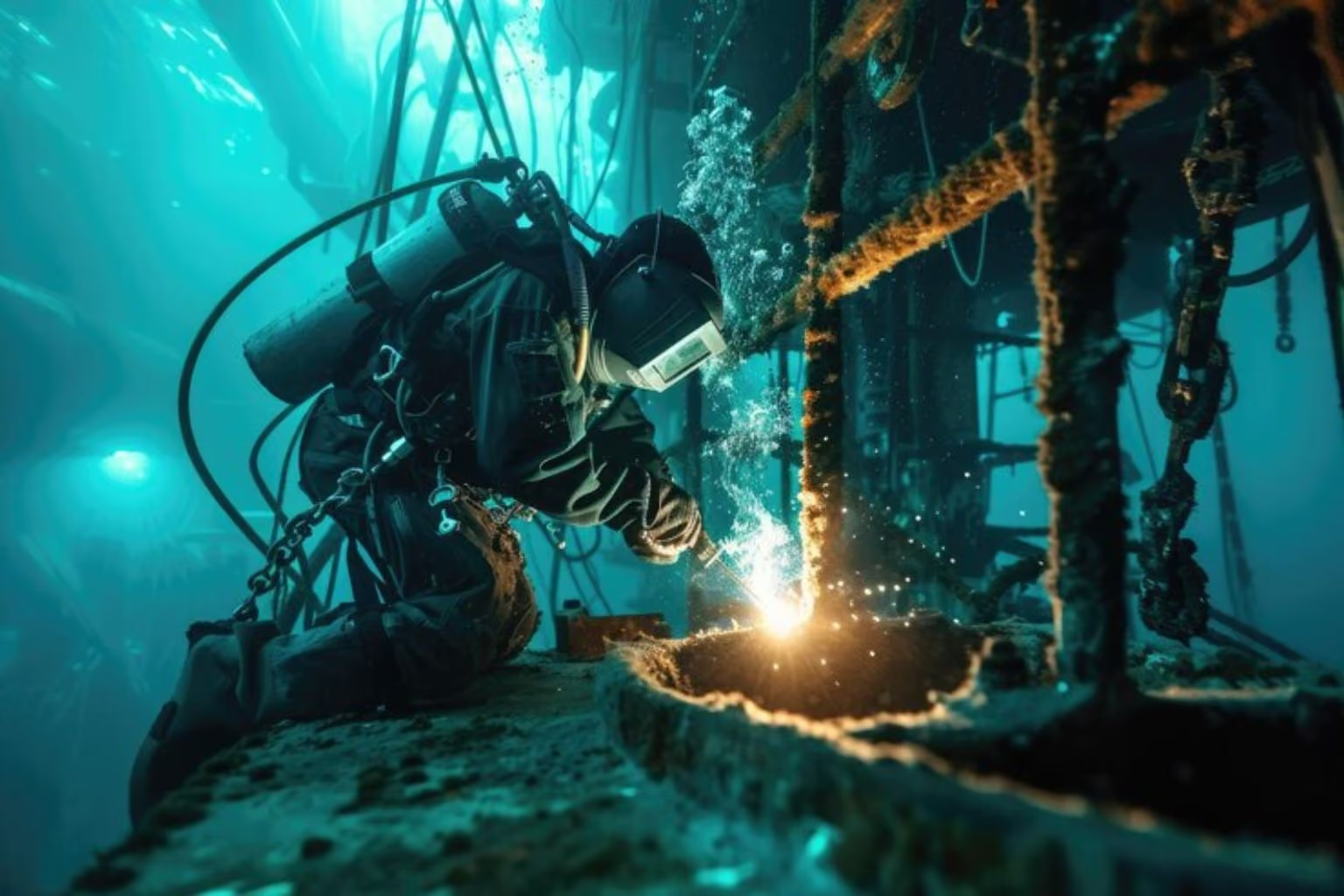
Explore underwater welding challenges, risks, and how the right gear enhances safety, precision, and performance for professional divers.
Steel bends differently when it sits beneath moving water. Heat behaves strangely. Visibility shifts without warning. And yet, critical infrastructure still demands precision cuts and flawless joins far below the surface. Underwater welding exists in that narrow space where engineering necessity meets physical exposure. It is not mysterious anymore. But it remains unforgiving.
This work keeps oil platforms stable, pipelines sealed, dams reinforced, and harbors operational. The public sees the romance of extreme pay figures. Professionals see a controlled environment that rarely feels completely controlled. Somewhere between those views sits the truth.
Underwater welding is not simply welding that happens underwater. It is a trade that reshapes how temperature, electricity, body position, and human reaction interact.
Water resists predictability. Current flow shifts. Arc stability fluctuates. Wet welding relies on direct current and waterproof electrode coatings designed to stabilize the arc in a constantly moving conductive environment. Dry hyperbaric welding removes water entirely by sealing the weld zone in a pressurized chamber. Both methods aim at control. Neither fully guarantees it.
Heat loss occurs at a rate unmatched on land. Molten metal cools fast. That rapid quenching affects bead formation, penetration, and final joint strength.
Silt, algae, rust particles, and sudden shifts in light force underwater welders to work by memory as often as by sight. Head-mounted lights help. They do not eliminate blind work.
It appears that muscle memory, more than any sensor, separates competent execution from scrap metal.
An underwater diver welder trains as both a commercial diver and a certified welder. The skill split is non-negotiable. Surface welders rarely transition smoothly into depth work without retraining the entire sensory system.
Breathing rate. Hand stabilization. Positioning while buoyant. These variables rewire how joints are executed.
The learning curve filters people fast.
Despite protective setups, current leakage remains a measurable threat. Insulation failure. Electrode damage. Unexpected grounding. Workers train to react before thinking.
Depth alters cognition. Judgment softens. Reaction time stretches. Then comes ascent risk. Decompression sickness remains one of the quiet statistics never fully erased.
Welding often happens on structures already compromised. Corrosion hides weakness. A single vibration can convert a working surface into a crushing hazard.
Underwater welding carries one of the highest occupational fatality rates within skilled trades. That observation does not fade with experience. It sharpens it.
Stories of six-figure earnings dominate forums. The reality breaks down differently.High compensation reflects cumulative risk exposure, not comfort. Pay fluctuates with contracts. Off periods stretch. Income stability depends on mobility and medical clearance.
It is believed that attrition, not entry difficulty alone, keeps pay elevated.
A helmet failure underwater becomes immediate. Commercial setups use sealed demand regulators, heating integration for cold water operations, and redundant airflow systems.
Thick gauntlets insulate electrically. Too thick and precision dissolves. Fine motor control survives only in a narrow material window.
Welding safety gear includes dry suits with layered dielectric properties. One puncture changes everything.
Gear ignorance is not forgiven by water.
Salt accelerates corrosion. Constant surge destabilizes posture. Projects run fast because downtime costs climb quickly.
Bridges, dams, and locks appear calmer. They sometimes hide worse visibility and entrapment hazards.
Unpredictable. Irregular. Often waiting months between contracts. It suits certain temperaments.
Underwater welding does not offer uniform career pathways. Specialization becomes the anchor point.
Pre-dive physiological checks. Equipment inspections. Communication rehearsals. Emergency extraction planning. All happen before a single arc strikes.
Underwater diver welder programs emphasize repetition under simulated stress. Panic training is deliberate.
It is not uncommon for candidates to exit certification midway, not from physical inability, but from accumulated mental strain.
Deadlines compress caution. Weather windows shrink work hours. Contracts expire. Human factors start nudging control systems.
It may be that the most dangerous moment in underwater welding arrives near project completion rather than at the start.
Fatigue is subtle. Water masks it well.
Arc stability has improved. Helmet optics now manage shifting light better. Heated suit layers extend cold tolerance. Yet fundamental exposure remains largely unchanged.
Automation experiments exist. Robotics assists in inspection more than in actual weld execution below complex structures.
For now, human presence remains necessary.
This is where product choices intersect quietly with safety decisions. Some divers lean toward custom-fitted welding apparel rather than generic sizing. Brands like Tentacle Tools build their gear from a practical lens since the founders operate inside the trade themselves. The benefit rarely comes from branding language. It shows up later in reduced snagging, better insulation balance, and fewer fatigue-driven errors.
Upgrade to Custom-Fit Welding Apparel – Experience Safety, Comfort, and Precision Like Never Before. Shop Now!
Energy infrastructure grows older. Offshore wind expands. Subsea maintenance demand increases rather than contracts.
At the same time, health screening standards tighten. Dive medicine grows stricter. Candidate pools shrink.
The profession may remain small. Compensation may continue to reflect scarcity more than glamour.
Underwater welding will likely never become safe in the conventional sense. It may become safer at the margins. That distinction matters.
Is underwater welding harder than land welding?
It appears more complex because buoyancy, arc behavior, and visibility all change simultaneously.
How long does it take to become an underwater diver welder?
Most dual certification paths require one to two years.
Are underwater welding pay rates reliable long-term?
Earnings fluctuate with contract availability and medical clearance.
What is the biggest safety risk in underwater welding?
Electrical exposure combined with decompression stress remains a top concern.
Does welding safety gear fully protect divers?
It reduces probability, not consequence.
Infrastructure keeps moving beneath shipping lanes, turbines, reservoirs, and platforms. Someone keeps it moving. Usually out of sight.
Underwater welding answers a problem few trades can reach. It does so through pressure, electricity, limited oxygen, and controlled nerves.
Not all progress announces itself above the surface. Some of it passes quietly through dark water and disappears again before most people ever notice it.
Explore insights, tips, and trends in tech and productivity!